
When a retreat advertises “intimate” or “small” groups, that’s a useful starting filter. It rules out the high-volume operations moving dozens of guests through ceremony with minimal personalized attention. On its own, though, “small” doesn’t tell you much about the actual quality of care.
Most retreat websites use “small group” as a feeling rather than a number. Some define small as under 20. Others mean under 12. A few use it for groups as large as 30, justified by the relative scale of even larger operations. The phrase, by itself, is doing emotional work, not informational work.
Look past the adjective and into the operational details. How many guests sit in a single ceremony? How many shamans hold that ceremony? How many facilitators are on the floor? Those three numbers tell you what a “small group” actually means in practice.
Consider two retreats that both host 12 guests per ceremony:
| Small Group Claim Alone | Small Group With Strong Support Ratios |
|---|---|
| 12 guests, 1 shaman, 1 facilitator | 12 guests, 3 to 5 Shipibo healers, 3 to 4 facilitators |
| Limited capacity to monitor everyone closely | Multiple sets of trained eyes throughout the night |
| Response time depends on one person being available | Support can reach a guest within seconds |
| Ceremonial and energetic work concentrated in one healer | Layered ceremonial presence across the maloca |
| Integration handled by overstretched staff | Personalized follow-up and reflection after each ceremony |
Safety in ayahuasca work is broader than emergency response. It includes the physical setting, the ceremonial practice itself, real-time observation, emotional support, clear communication when someone needs help, and follow-through after the medicine wears off. A small group can still feel under-supported if the staffing model behind it is thin.
The more useful question isn’t “how many guests are there?” It’s “how many qualified people are present to hold, monitor, and guide those guests?”
Ayahuasca ceremonies move through deep terrain. Some guests experience intense purging, vomiting that lasts for hours, or temporary disorientation. Others encounter resurfacing trauma, panic, emotional release that asks to be witnessed, or moments where they need quiet guidance back into their bodies.
According to the Global Ayahuasca Survey, a study of more than 10,000 ayahuasca users published in PLOS Global Public Health, roughly 70 percent of participants reported physical adverse effects and nearly 56 percent reported mental health adverse effects during or after ceremony (Bouso et al., 2022). These are not rare experiences. They are part of the work.
What changes when staffing is built to meet that reality:
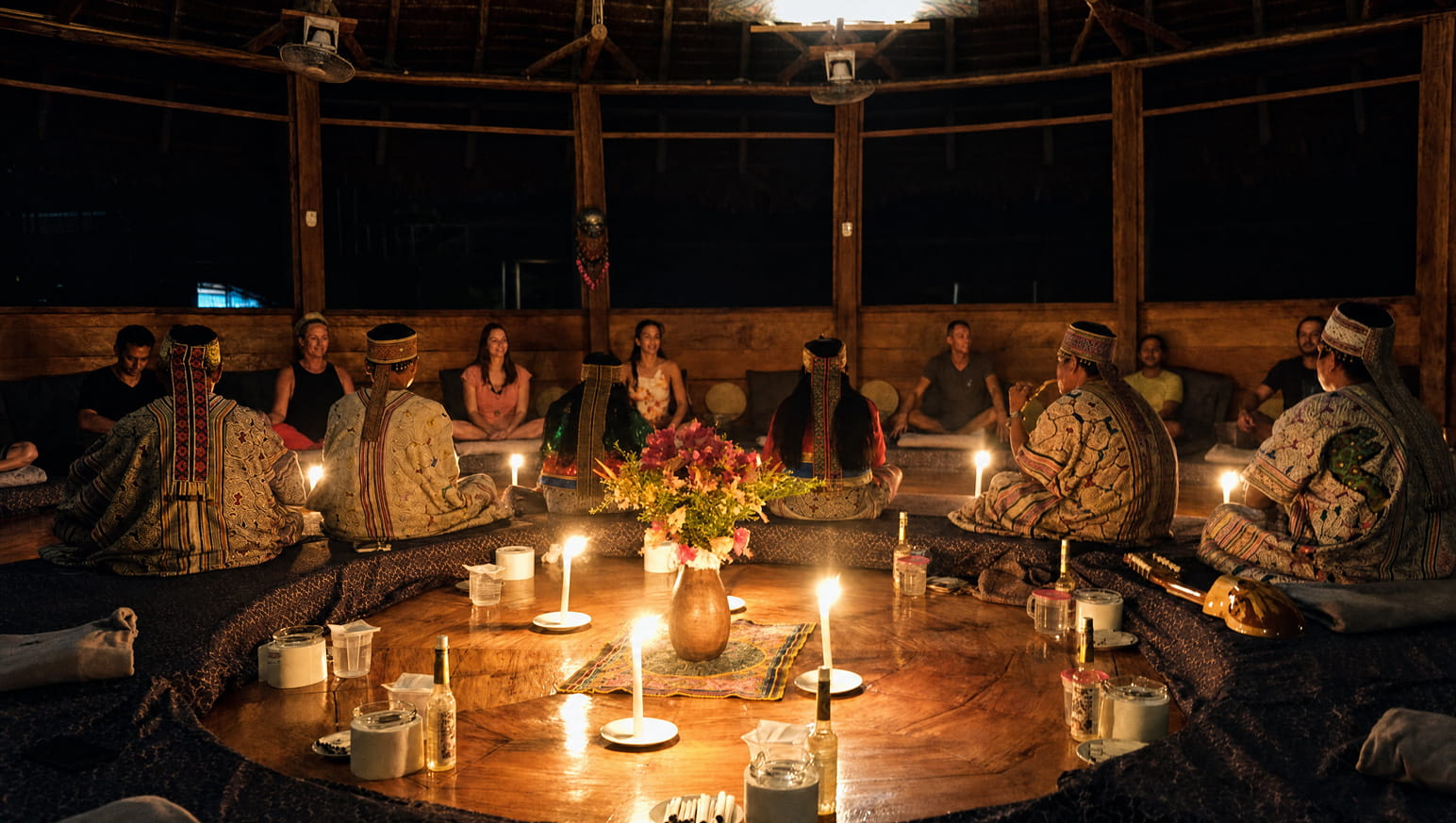
A single ceremonial leader holds the room. Three to seven Shipibo healers hold it differently. They can move icaros to specific guests as needed, layer their songs over each other for guests in deeper places, and bring direct medicine work to whoever needs it most in any given hour. To understand more about how this lineage of healing actually works, see our guide to Shipibo shaman ayahuasca ceremonies in Peru.
The ceremonial space itself becomes more spacious, because attention can move where it’s required without thinning out the broader ceremony. Someone in their first ceremony, someone returning for their fifth, and someone working through a specific intention can each receive what they need without one of them being overlooked.
Facilitators are not shamans, and the distinction matters. Their role is practical: monitoring guests throughout the night, assisting with purging, offering grounding when someone is disoriented, and coordinating with the healers when a guest needs more direct attention. They are the team you talk to
When the room is well staffed, you stop wondering whether anyone will notice if you need help. That single shift, knowing you are seen, changes how deeply you are willing to surrender.
At Arkana, ceremonial support is not concentrated in one or two people overseeing the entire room. Each ceremony is held by a team of Shipibo healers and trained facilitators working together, with overlapping responsibilities and clear communication throughout the night.
| Element | Arkana Model |
|---|---|
| Guests per ceremony | Approximately 15 to 25, depending on location and program |
| Shipibo healers present | Three to seven, depending on the retreat |
| Staff-to-guest ratio | Approximately 1:3 |
| Lead healer | Maestra Justina, a Meraya-lineage healer with over 45 years of practice |
| Additional senior healers | Maestro Cesar and Maestro Eligio, each with decades of practice |
| Healer continuity | The same family grows, harvests, and cooks Arkana's ayahuasca on the Vencedor plantation |
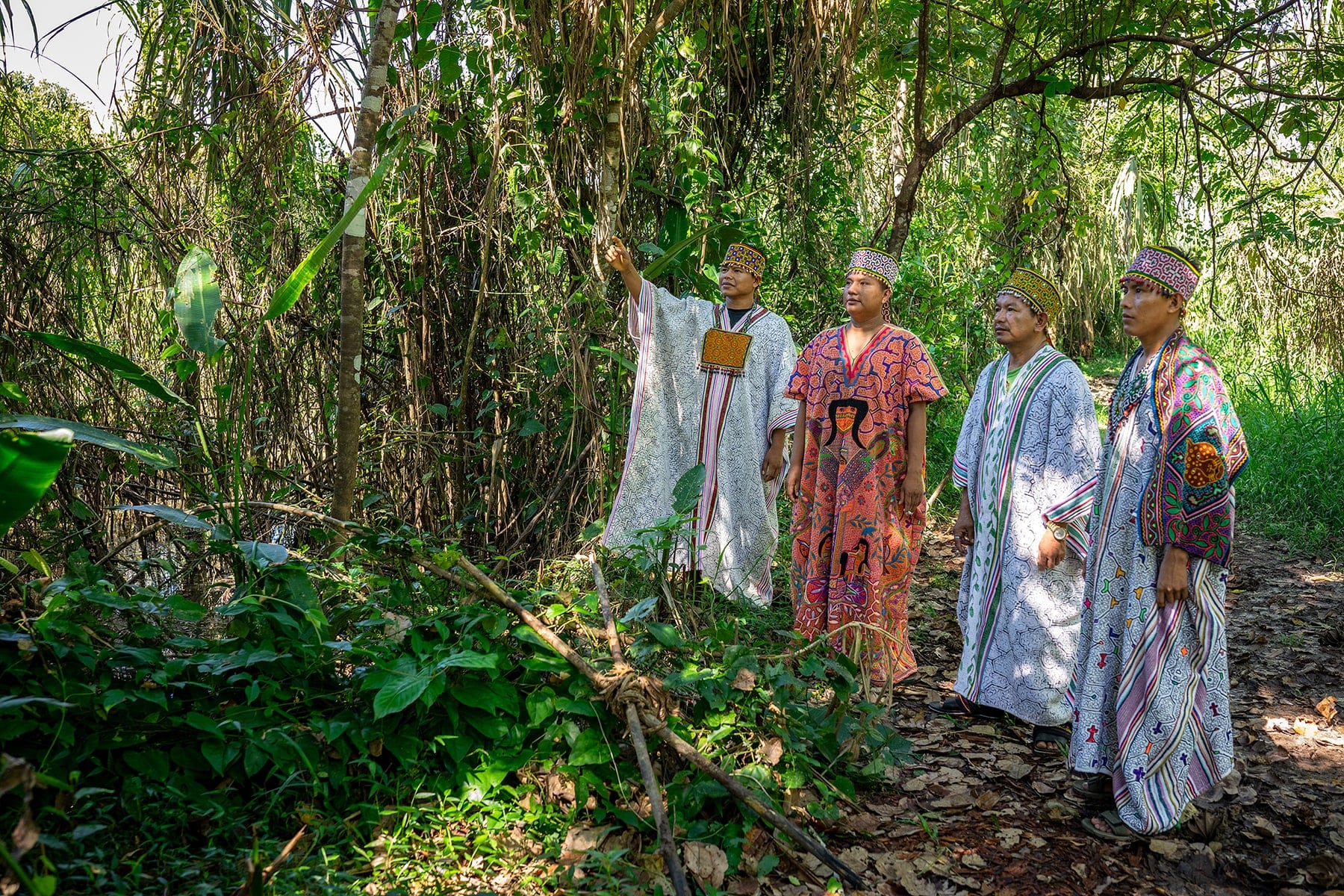
The Shipibo healers carry the ceremonial work itself: icaros sung directly over each guest, the energetic field of the room, and the personalized adjustments that come from generations of practice. Maestra Justina is a direct descendant of Merayas, the highest-ranked healers in Shipibo shamanic tradition, and she practices shamanic surgery weekly, a skill that is increasingly rare even among experienced curanderos.
Maestro Cesar, known as Paparahua, brings over 50 years of his own practice. Between retreats he returns to the family’s home community of Vencedor on the Pisquí River to manage Arkana’s 100-acre ayahuasca plantation. Maestro Eligio, also from Vencedor, completes the senior healer team.
The continuity matters. The ayahuasca poured at an Arkana ceremony was grown, harvested, and cooked by the same family that sings over you that night. That relationship between healer, plant, and ceremony is something most retreat operations cannot offer at any scale.
The facilitator team works in coordination with the healers, offering attentive monitoring throughout the ceremony, assistance with purging and grounding, and the practical communication that keeps a guest connected to support without interrupting the ceremonial space. This is not background staff. It’s a trained team whose presence is part of what makes the room safe.
This isn’t a marketing claim we hope will reassure you. It’s the operational structure of every retreat we run, and you are welcome to ask our team directly how many healers and facilitators will be present at the specific retreat you’re considering. Transparency is part of how we believe safety should be built.
Strong support ratios aren’t only about responding to difficult moments. They shape the depth of healing that becomes possible when guests feel held.
When you know that someone qualified will notice if you need help, your nervous system relaxes in a different way. Surrender becomes possible. The defenses that normally protect you can soften, because they don’t have to do all the work themselves. Well-supported guests often report being able to go further into the experience than they thought they could.
What this changes therapeutically:
The Global Ayahuasca Survey found that 88 percent of respondents who experienced negative psychological effects still viewed them as important for their growth (Bouso et al., 2022). That outcome depends heavily on whether those experiences are supported well in the moment.
Integration begins the morning after the medicine. Strong staffing means there is bandwidth for personalized reflection, follow-up conversations, and the kind of unhurried attention that helps guests make sense of what they experienced. Without that, the ceremonial peaks fade into ordinary memory rather than becoming durable insight. Our 8P integration method is designed to turn those peaks into lasting change.
The medicine does its work, but the people in the room shape what’s possible to receive from it.
Before you book any retreat, ask specific questions about staffing and process. Vague answers are a signal. A credible retreat should be able to describe its support model clearly. Use this checklist with any retreat you’re researching, including ours. An academic review of publicly advertised psychedelic retreat organizations found wide variability in safety practices across the industry, which is why specifics matter so much more than marketing language.
The retreats worth your trust are the ones that welcome these questions and answer them concretely. The ones that deflect are telling you something important too.
Group sizes vary widely. Some retreats hold ceremonies with as few as six to eight participants. Others run groups of 25 to 30. At Arkana, ceremonies typically include 15 to 25 guests depending on the location and retreat format. The more important number, regardless of group size, is how many qualified healers and facilitators are present to support those guests.
A small group can be safer when the staffing model is strong, but small group size alone does not guarantee safety. A group of ten guests with a single ceremonial leader is less well supported than a group of fifteen guests held by three healers and four facilitators. When you compare retreats, look past the headline number to the ratio of guests to qualified staff.
There is no single industry standard, but research and expert guidance on psychedelic-assisted group facilitation suggests participant-to-facilitator ratios of around 1:3 to 1:5 allow for close monitoring. For shamans or healers, the meaningful question is whether more than one ceremonial leader is present, since a single leader concentrates all of the ceremonial work in one person. At Arkana, three to seven Shipibo healers are present per ceremony alongside a 1:3 facilitator-to-guest ratio.
Responsible retreats anticipate difficult experiences as a normal part of ceremony, not an emergency. Trained facilitators monitor guests throughout the night and respond to purging, disorientation, panic, or emotional release with grounding, breath support, or direct attention from a healer. The key signal is whether the retreat treats challenging moments as part of the work or as disruptions to be managed quickly.
Ayahuasca interacts dangerously with SSRIs and other antidepressants, and most reputable retreats require guests to taper off these medications well in advance under medical supervision. A peer-reviewed systematic review of ayahuasca adverse events describes the theoretical risk of serotonin syndrome when ayahuasca is combined with serotonergic psychiatric medications. Medication tapering is a medical decision and must be done in consultation with the doctor who prescribed the medication — never on your own. If a retreat does not ask about your medications during screening, that is a significant warning sign. If ayahuasca is medically contraindicated for you, some retreats, including Arkana, offer alternative ceremonial programs with other medicines.
Our guide explains the serotonin syndrome risk and which drug classes are involved.
Ask about group size, the number of shamans and facilitators per ceremony, the screening process, how difficult experiences are handled, what post-ceremony integration includes, and whether the retreat will explain its staffing model in writing. A credible retreat answers these questions directly. Vague or evasive responses are a signal to keep looking.
Our differentiator isn’t the language we use about small groups. It’s the level of healer and facilitator presence built into every ceremony we run, and the lineage of the people who hold them.
If safety and support are central to your decision, a few places to start:
Choosing where to sit with ayahuasca is one of the most important decisions you’ll make about this medicine. Ask the questions that matter. Trust the retreats that answer them clearly. That instinct is already part of the healing.
Bouso, J. C., Andión, Ó., Sarris, J. J., Scheidegger, M., Tófoli, L. F., Opaleye, E. S., Schubert, V., & Perkins, D. (2022). Adverse effects of ayahuasca: Results from the Global Ayahuasca Survey. PLOS Global Public Health, 2(11), e0000438. https://doi.org/10.1371/journal.pgph.0000438
White, E., Kennedy, T., Ruffell, S., Perkins, D., & Sarris, J. (2024). Ayahuasca and dimethyltryptamine adverse events and toxicity analysis: A systematic thematic review. International Journal of Toxicology, 43(1). https://journals.sagepub.com/doi/10.1177/10915818241230916
Society for the Advancement of Psychotherapy. Best practices in psychedelic-assisted group psychotherapy. https://societyforpsychotherapy.org/best-practices-in-psychedelic-assisted-group-psychotherapy/
Reported safety practices of publicly advertised psychedelic retreats. National Library of Medicine, PMC12780929. https://www.ncbi.nlm.nih.gov/pmc/articles/PMC12780929/