


Ibogaine and ayahuasca are both plant medicines with deep ceremonial roots, and people often weigh one against the other. The differences are large. Ibogaine comes from the root bark of iboga, an African shrub, and its effects unfold over a day or more. Ayahuasca is an Amazonian brew of vine and leaf whose effects last roughly four to six hours. The most important difference is medical: ibogaine carries a documented risk to the heart's rhythm, which researchers watch with continuous ECG monitoring.
Arkana does not offer ibogaine or iboga. Our ceremonies in Peru are with ayahuasca, and you can see the medicines Arkana works with on our retreats. Most of what you will find when you search this comparison is written by clinics that sell ibogaine. This guide compares the two with nothing to sell on the ibogaine side: what each medicine is, how long it lasts, what the research shows, and why the heart sits at the centre of the safety conversation.
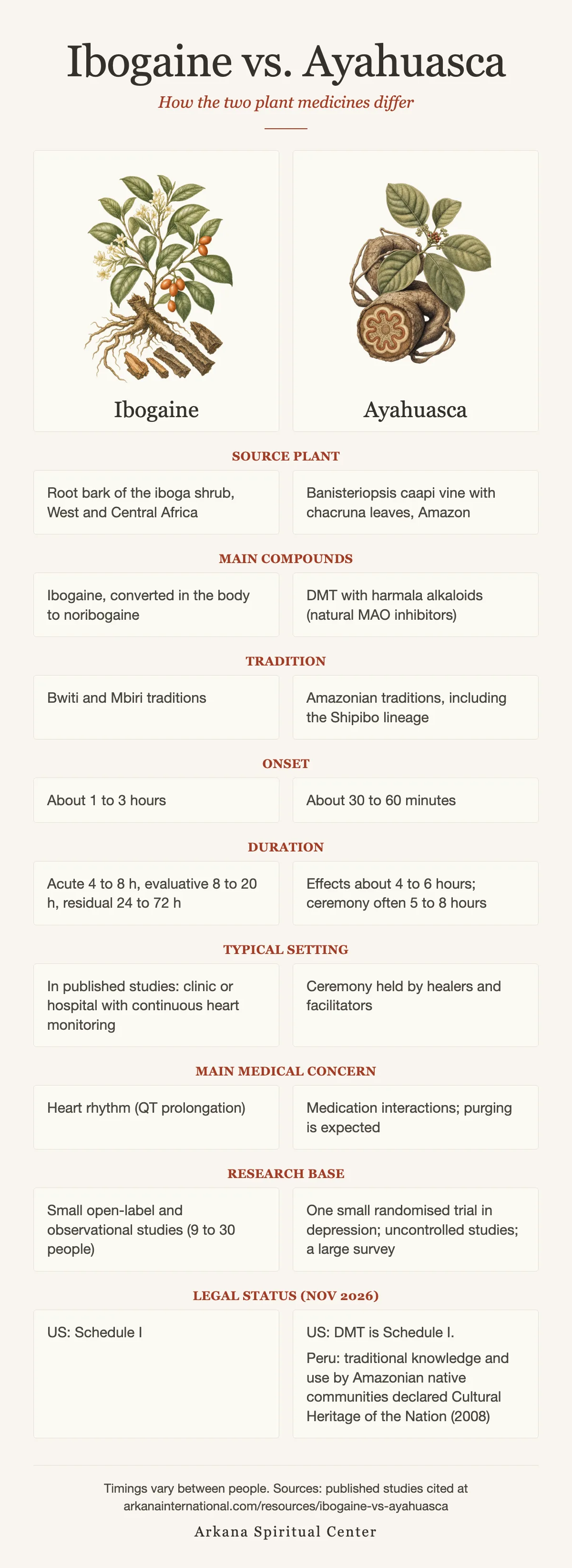
| Ibogaine | Ayahuasca | |
|---|---|---|
| Source plant | Root bark of the iboga shrub, West and Central Africa | Banisteriopsis caapi vine with chacruna leaves, Amazon |
| Main compounds | Ibogaine, converted in the body to noribogaine | N,N-DMT with harmala alkaloids, natural MAO inhibitors |
| Tradition | Bwiti and Mbiri traditions | Amazonian traditions, including the Shipibo lineage |
| How taken | By mouth, as capsules or liquid in studies | By mouth, as a brew |
| Onset | About 1 to 3 hours | About 30 to 60 minutes |
| Duration | Staged: acute about 4 to 8 hours, evaluative about 8 to 20 hours, residual about 24 to 72 hours | Effects roughly 4 to 6 hours; ceremony often 5 to 8 hours |
| Typical setting | In published studies, a clinic or hospital with continuous heart monitoring | A ceremony held by healers and facilitators |
| Main medical concern | Heart rhythm (QT prolongation); temporary unsteadiness | Purging is expected; medication interactions |
| Research base | Small open-label and observational studies, 9 to 30 people | One small randomised trial in depression, uncontrolled studies in substance use, a large survey, a 2024 systematic review |
| Legal status (Nov 2026) | US: Schedule I | US: DMT, its main active compound, is Schedule I. Peru: traditional knowledge and use by native Amazonian communities declared Cultural Heritage of the Nation (2008) |
Ibogaine is the main psychoactive alkaloid in iboga (Tabernanthe iboga), a shrub native to West and Central Africa. A 2018 review in ACS Chemical Neuroscience notes that iboga has been used for centuries by the Bwiti and Mbiri traditions.
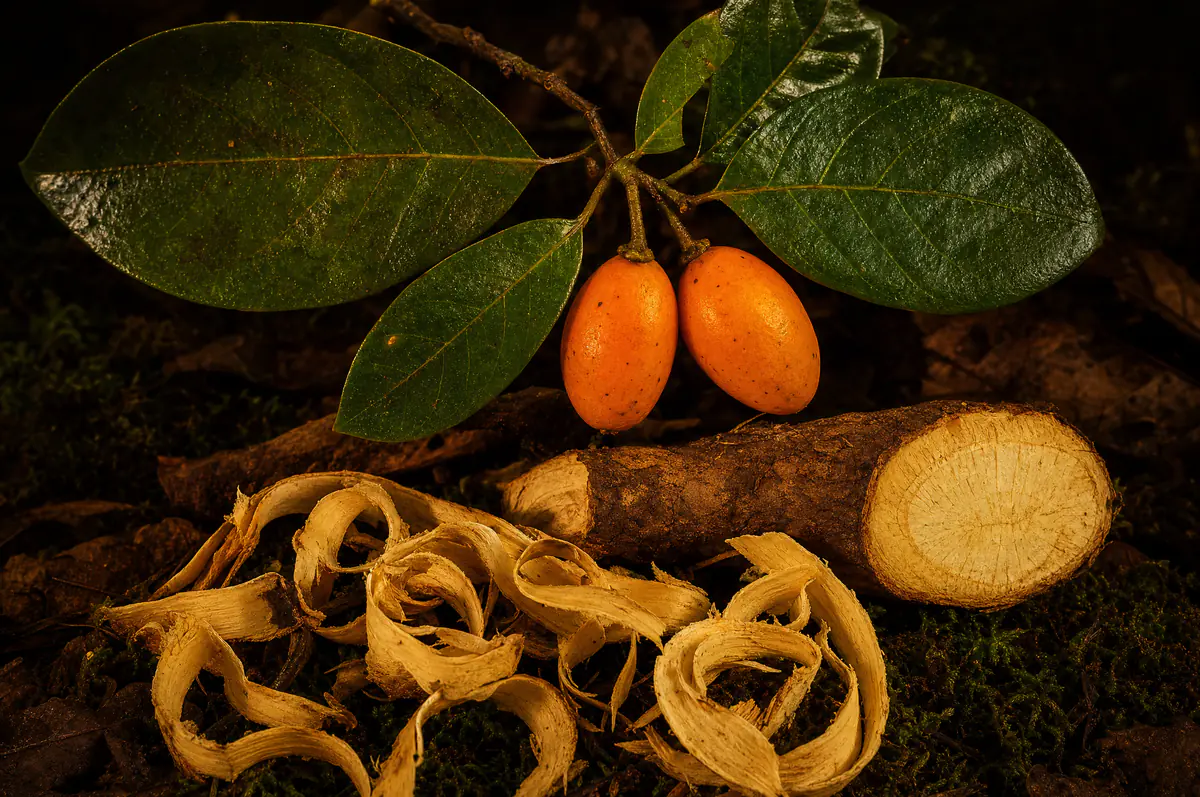
In the body, a liver enzyme called CYP2D6 converts ibogaine into noribogaine, which a 2015 review by Koenig and Hilber describes as far longer-lived than ibogaine itself. In clinical studies, ibogaine is taken by mouth, as capsules or liquid. Most commercial ibogaine is not extracted from iboga at all: chemists report that it is made mainly from voacangine, a compound in a different African plant, Voacanga africana.
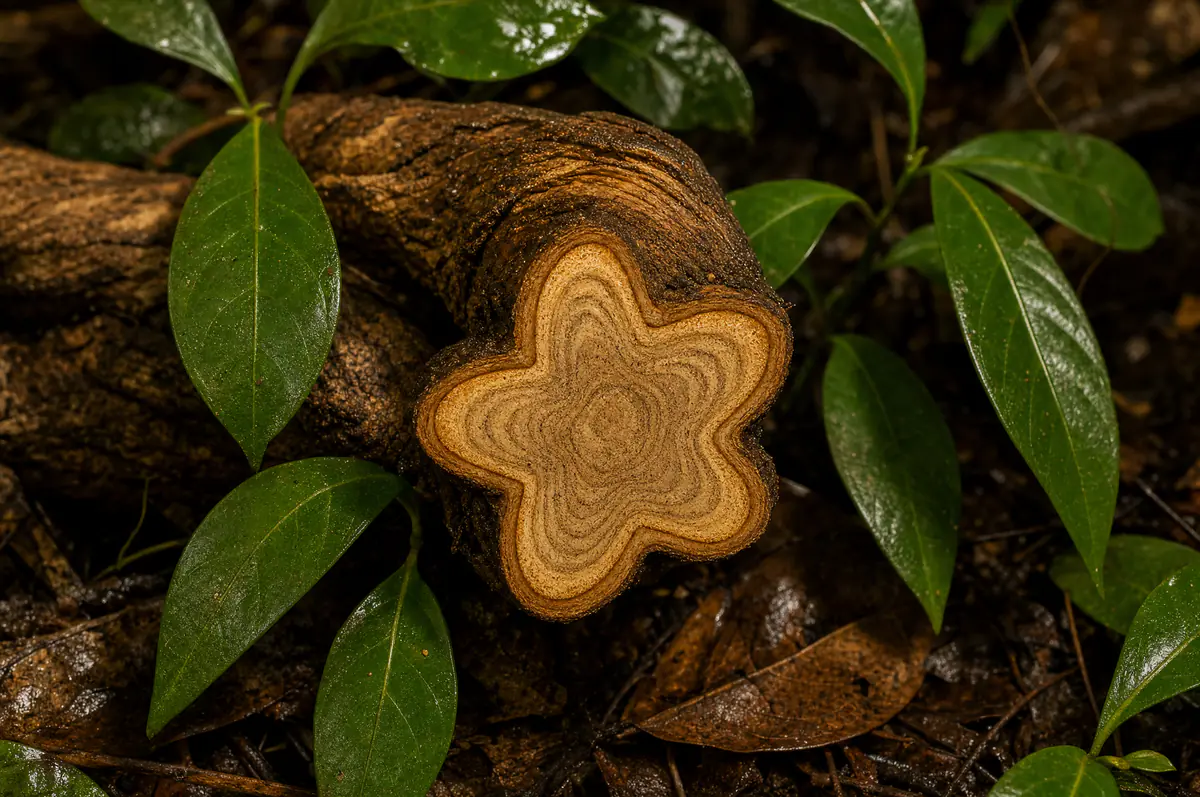
Ayahuasca is a brew from the Amazon, made from the Banisteriopsis caapi vine and the leaves of Psychotria viridis, known as chacruna. The leaves supply N,N-DMT, and the vine supplies harmala alkaloids (harmine, harmaline and tetrahydroharmine), natural MAO inhibitors that let DMT work when taken by mouth. Our complete guide to ayahuasca covers the medicine and its tradition in depth.
Ibogaine lasts far longer. Effects usually begin about one to three hours after a dose and then move through stages, as described in a review by Alper and summarised in a 2024 study in Nature Medicine: an acute phase of about 4 to 8 hours, an evaluative phase of about 8 to 20 hours, and a residual phase of about 24 to 72 hours. In published studies, people were monitored for 12 to 16 hours, or for at least 24 hours, after the dose.
Ayahuasca is shorter. In a small laboratory study of six volunteers, Riba and colleagues found effects began at 30 to 60 minutes and had resolved by about four hours. In ceremony, effects last roughly four to six hours, within an evening that often runs five to eight. Our article on how long ayahuasca lasts walks through that timeline. With both medicines, individual responses vary.
Iboga is central to Bwiti, a spiritual practice that the Chacruna Institute describes as practised in Gabon. We are not keepers of that tradition, and we speak about it only from the published record. Ayahuasca is held by many Amazonian peoples; in Arkana's case it is the Shipibo tradition, carried by our Maestras and Maestros through icaros, the sacred songs sung in ceremony. Our guide to ayahuasca shamanism and its Indigenous roots explores that lineage more fully.
Not according to the IUCN Red List, which assessed iboga in 2018 as Least Concern, with a stable population. That assessment is now several years old. The Chacruna Institute notes that no detailed biological studies of wild iboga populations are available, and reports concern about harvesting for export.
At Arkana, we offer authentic ayahuasca experiences at two sacred locations in Peru. Each carries its own medicine, its own teachings, its own perfect timing for different souls.


Peru

1–3 Week Programs • Year-Round

Peru
1–3 Week Programs • Year-Round
The clearest safety difference is the heart. Ibogaine can lengthen part of the heart's electrical cycle, seen on an ECG as a longer QT interval, and case reports have linked this to dangerous heart rhythms and to deaths. Ayahuasca's safety picture is different, as described below.
A 2015 review by Koenig and Hilber explains that ibogaine and noribogaine block hERG channels, prolonging the electrical cycle of each heartbeat, and that QT prolongation after a single dose typically lasts more than 24 hours. A 2026 review in Addiction describes case reports of torsades de pointes (a dangerous, irregular heart rhythm) and cardiac arrest at therapeutic doses, including in people with no known heart disease, and calls this a "rare yet clinically significant cardiotoxic risk."
Alper, Stajic and Gill identified 19 people outside West Central Africa who died between 1990 and 2008 within 1.5 to 76 hours of taking ibogaine. In 12 of the 14 cases with adequate postmortem data, pre-existing medical conditions or other substances explained or contributed to the death. These deaths are associated in time with ibogaine, which is not proof that ibogaine alone caused each one. In a small New Zealand study, one of 14 participants died during treatment; the abstract does not give a cause.
In a 2022 hospital study in the Netherlands, 14 patients with opioid dependence each received a single dose under continuous monitoring. Half saw their heart-rate-corrected QT interval go above 500 milliseconds, and all 14 had severe but temporary unsteadiness; no torsades de pointes was observed. The 2024 veterans study described below gave intravenous magnesium with continuous ECG and reported no clinically meaningful QT prolongation on monitoring, but it had no comparison group and excluded people with heart, liver or kidney problems, so it cannot show that magnesium protects. The 2026 Addiction review recommends medical supervision, CYP2D6 genotyping and rigorous cardiac monitoring. In October 2026, the FDA's drug center director said, "With ibogaine, there are important scientific questions as well as serious safety concerns" (FDA).
Beyond the heart, studies most often report unsteadiness (ataxia), tremor, nausea and vomiting, headache, anxiety, a slow heart rate and low blood pressure. In the veterans study, all 30 participants had temporary unsteadiness or tremor that resolved within 24 hours. A 2022 systematic review also describes effects lasting beyond 24 hours, mostly from case reports, and notes that causation cannot be clearly established.
Purging is an expected part of an ayahuasca ceremony. Serious medical complications are rare, especially when guests are screened in advance: a 2024 systematic review in the International Journal of Toxicology found serious adverse effects rarely reported in healthy populations. At Arkana, every guest completes a medical intake and an onboarding medical call before arrival. Our medical director, Dr. Arturo Sáenz, oversees our safety protocols, and our staff and facilitators follow them at every ceremony.
Our screening is practitioner-led, and medications, including SSRIs, SNRIs and MAOIs, are reviewed as part of it. In the Global Ayahuasca Survey of 10,836 self-selected respondents, published in 2022, vomiting was the most common acute physical effect and 2.3% reported needing medical attention. Read more about ayahuasca side effects and risks and our medical screening process.
The research on both medicines is early, and no study compares the two head to head. The human ibogaine studies we reviewed are open-label or observational, with 9 to 30 participants and no comparison group.
The best-known is Cherian and colleagues' 2024 paper in Nature Medicine, an open-label observational study of 30 male US Special Operations veterans, most with mild traumatic brain injury. Stanford researchers carried out the assessments, but ibogaine was given at a clinic outside the US, and the paper states that Stanford played no role in administering ibogaine. Participants chose to travel for treatment, and some authors held shares in the company that runs the clinic. The researchers reported reductions in measures of disability, PTSD, depression and anxiety one month later.
A 12-month follow-up published in 2026 found those reductions sustained among the 25 participants who completed it, though most had used other psychedelics or interventions during that year, and the authors call for randomised controlled trials. A smaller uncontrolled 2018 study of 30 people with opioid dependence reported reductions in withdrawal and drug use. These results describe the people studied, in their settings, and individual responses vary widely.
For ayahuasca, a 2019 randomised placebo-controlled trial of 29 people with treatment-resistant depression found lower depression scores than placebo in the week after a single dose. It was a small clinical study, not a retreat. We do not rank either medicine for any condition.
Researchers have also studied ayahuasca among people with substance use problems, though the work is early. As of November 2026, we found no randomised controlled trial of ayahuasca for addiction. In Canada, Thomas and colleagues (2013) followed 12 people from a First Nations community through a four-day programme of group counselling and two ayahuasca ceremonies; in this preliminary observational study, self-reported use of alcohol, tobacco and cocaine declined over six months, while cannabis and opiate use did not. Other studies come from Takiwasi, a residential centre in Tarapoto, Peru, that runs its own months-long programme and is separate from Arkana. There, Berlowitz and colleagues (2019) assessed 53 men at admission and again at the end of their stay, with 36 analysed at completion and no control group, and call their findings preliminary given the design. Rush and colleagues (2024) followed 52 participants for a year in an observational study known as ATOP, also without a comparison group, and write that its limitations "preclude conclusions about causal associations."
Reviews by Nunes and colleagues (2016) and Rodrigues and colleagues (2022) describe this evidence as observational and preliminary, and both call for controlled trials. These studies describe particular groups of people in particular programmes, not what any retreat will bring, and individual responses vary widely. For the wider picture, the research section of our ayahuasca guide places the ATOP data alongside other studies.
No peer-reviewed study has examined ibogaine together with ayahuasca, its harmala alkaloids or MAO inhibitors in people. The 2016 clinical guidelines of the Global Ibogaine Therapy Alliance, written by a group of ibogaine providers, say it is not known whether or to what extent MAOIs interact with ibogaine.
There is also a theoretical reason for caution, not a measured result. A 2015 study in healthy volunteers given a very small dose found that blocking the CYP2D6 enzyme roughly doubled exposure to ibogaine and noribogaine, and harmine and harmaline, two of ayahuasca's alkaloids, inhibit CYP2D6 in laboratory tests. Whether that adds up to a real risk in people has never been tested.
At Arkana, we never combine ayahuasca with any other psychedelic or plant medicine in a ceremony; we stay with traditional shamanic practice. If you have used ibogaine or any other medicine, it belongs in your medical intake, so our team can review your full history. Our guide to preparing for an ayahuasca journey explains the rest of what happens before ceremony.
Ibogaine is a Schedule I controlled substance in the United States, according to the federal schedules of controlled substances. DMT, the main active compound in ayahuasca, is also Schedule I. Federal activity on ibogaine research grew in 2026 without changing that status. Executive Order 14401 (April 2026) directed the FDA and DEA to establish a pathway for eligible patients to access psychedelic drugs, including ibogaine compounds, under Right to Try. The FDA then allowed an early-phase study of noribogaine, an ibogaine derivative, and in October asked for input on ibogaine trial design.
State laws vary. In 2022, Colorado voters passed Proposition 122, which decriminalized the personal possession, sharing and use, but not the sale, of ibogaine and DMT for adults 21 and over under state law, according to the state's official ballot guide. A 2026 Colorado law added an ibogaine research pilot, and Texas (2025), Mississippi and Kentucky (2026) have passed laws to fund or organise ibogaine research. None of these state laws makes ibogaine generally available or changes its federal status. Texas's health agency has said the trial plans submitted so far did not meet its law's requirements. These details change quickly.
Our ceremonies take place in Peru. There, a resolution of the Instituto Nacional de Cultura (RDN 836/INC, 24 June 2008) declared the traditional knowledge and uses of ayahuasca by native Amazonian communities Cultural Heritage of the Nation. Internationally, the brew itself is not under control, according to the International Narcotics Control Board, though DMT as an isolated compound is. This applies to ayahuasca only. Legal standing also says nothing about how carefully any centre screens its guests.
Because no research compares these medicines directly, the honest question is not which is better, but what you are seeking and what your health allows.
Some people compare these medicines because of addiction. Arkana works with and supports guests who are struggling with addiction, alongside their own medical care rather than in place of it, and the first step is the same practitioner-led screening every guest completes. Your safety comes first: if you are dependent on opioids or alcohol, or take a prescribed medication, please speak with your own doctor before any plant medicine, and do not stop or reduce a prescribed medication on your own. If you are considering ibogaine, its effect on the heart is one more reason to involve a doctor.
These reflect safeguards described in the research above, not a recommendation to take ibogaine. If you are weighing other medicines too, our guide to Bufo vs ayahuasca takes the same approach.
No study compares the two head to head, so there is no evidence-based way to call either stronger. They differ in measurable ways: ibogaine's effects unfold over a day or more, with continuous heart monitoring in research settings, while ayahuasca's last roughly four to six hours.
Ibogaine begins about one to three hours after a dose, then moves through an acute phase of about 4 to 8 hours, an evaluative phase of about 8 to 20 hours and a residual phase of about 24 to 72 hours. Ayahuasca begins within 30 to 60 minutes and lasts roughly four to six hours.
The most serious is QT prolongation, a change in the heart's electrical rhythm that case reports have linked to dangerous arrhythmias and cardiac arrest. Studies also report unsteadiness, tremor, nausea and vomiting, headache, anxiety, a slow heart rate and low blood pressure.
No peer-reviewed study has examined the combination. An alliance of ibogaine providers says it is not known whether MAOIs interact with ibogaine, and ayahuasca's alkaloids inhibit an enzyme ibogaine depends on in laboratory tests, a concern never tested in people. Arkana never combines ayahuasca with any other medicine in a ceremony.
As of November 2026, ibogaine is a Schedule I controlled substance under federal law. A 2026 executive order, FDA research steps and state laws, including Colorado's decriminalization of personal use and research laws in Texas and Kentucky, have not changed that federal status.
Yes. Arkana works with and supports guests who are struggling with addiction, alongside their own medical care rather than in place of it. Every guest begins with practitioner-led screening, which reviews health history and medications. Arkana does not offer ibogaine or iboga, and we cannot promise any particular outcome.
If ayahuasca is the medicine you feel drawn to, the most useful next step is usually a conversation rather than more comparison. Our team is glad to talk through your intentions, your health history and what a ceremony in Peru involves.


